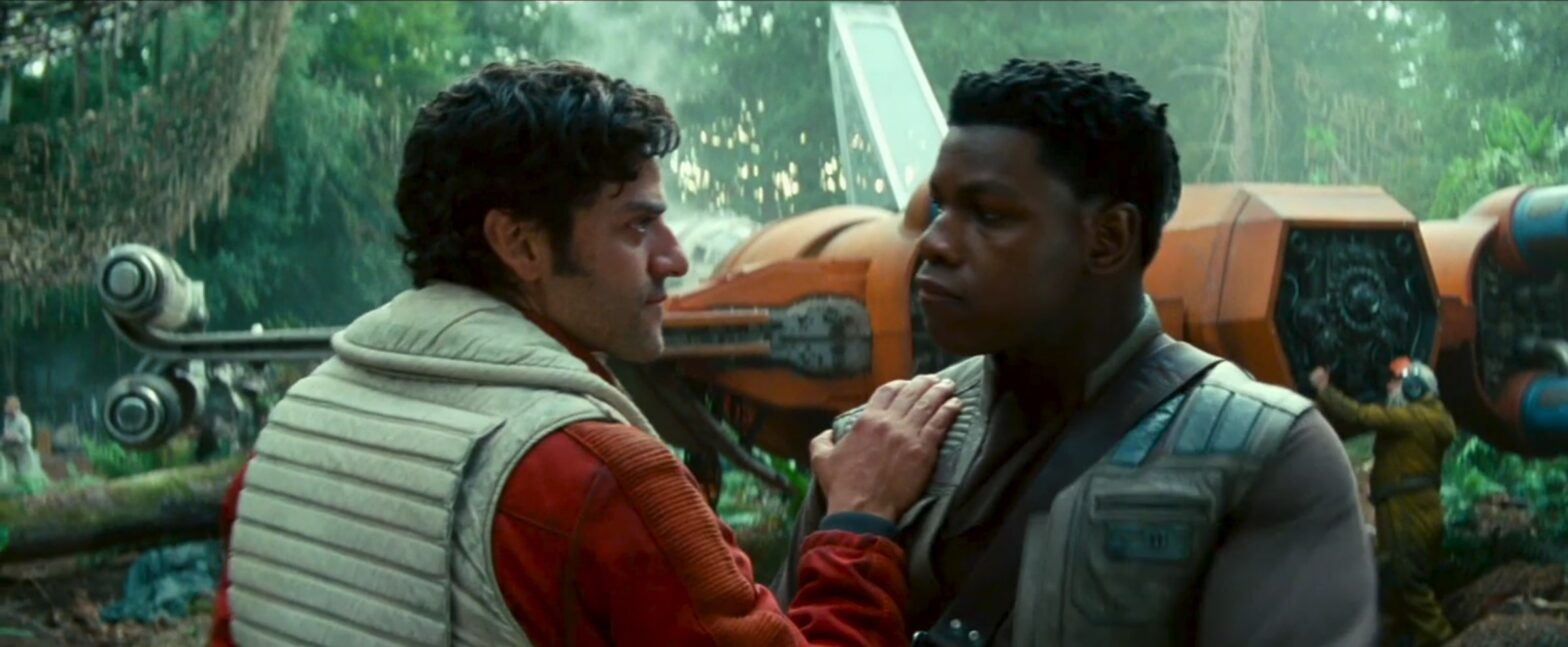
Image: Poe Dameron and Finn from The Rise of Skywalker
I’m not a great fan of the recent crop of Star Wars films but, during the Christmas holidays in 2020, I took my family to see the finale of the trilogy of trilogies, The Rise of Skywalker.
As expected, it was a curate’s egg, with even the good elements struggling to lend it gravitas. Nonetheless, a recurring theme that interested me was the desperate need for friendship among the characters and for the skill, courage and – above all – the inspiration and hope of others in order to win the day.
Of course, it was all underscored with emotional cries of, “We’re not leaving you!” or “We’re coming with you!” or “I can’t do this on my own!” – but it was a quote from Poe Dameron, as a newly promoted General discussing plans for the final stand, that really struck me. He said, “The First Order wins by making us think we’re alone. We’re not alone. Good people will fight if we lead them.”
Replace The First Order with Satan and you have the key to the devil’s mission – isolate and conquer.
In the Garden of Eden, God saw that it was not good for man to be alone and so created him a helpmate. Satan’s immediate response was to come between Adam and Eve and to tell them they could be gods, omnipotent and without the need of anyone’s help. But one can only feel godlike by separating oneself from those who are not, leaving them abandoned and isolated in their own way; as always, the devil makes godlike separation an attractive proposition, but the reality is a spiral into self-centred isolation and lonely despair.
Men, in particular, can fall for this ‘godlike ideal’. At one end of the scale, there is the independent, self-sufficient, invincible alpha male, with his high-flying job, trophy wife and expensive, secluded homestead. But it always surprises people when the more extreme of these types turn on their wife and kids and then shoot themselves in an act of despair when their lives go horribly wrong, often through debt or divorce. They can’t handle the isolation, sudden vulnerability and loss of control – and helplessness quickly becomes hopelessness.
At the other end of the scale there is the man who wants a sedate, comfortable and uninterrupted life, with his TV, Playstation and takeaways, happy to let his wife carry the burden of raising the family. And somewhere along the spectrum there may be the man who buries his head in work, or travel, or hobbies, or in some other way avoids engaging with the reality of other people.
Not all men are like this, of course. And many Catholic men have their isolation imposed on them when they find themselves just about the only male attending Mass. Despite a strong desire for fraternity, they are frustrated by the complete absence of men, let alone those with whom they might share real friendship. Their loneliness stems from being abandoned rather than having deliberately withdrawn themselves from fraternity.
Yet try to convince Catholic men to join a men’s group and you often meet an extraordinary level of resistance: “I’d love to come but I can’t! The wife, the kids, the job, the house! I have no time! Now is not the right time!” It’s as if we have become too comfortable in the isolation-we-know to muster the strength to commit to the fraternity-we-don’t! Busy individualism has become the new normal to the extent that leisurely fraternity looks like madness.
Subconsciously, I believe, the real reason is that men know that fraternity will make humbling demands of them. It will challenge them to do the things they should be doing as men, but don’t because there is no one holding them accountable. Isolation makes us inert, inertia makes us susceptible to temptation and sin, and sin further isolates us from our brethren and from God. Ask any man addicted to pornography and he’ll tell you it becomes a lonely and shameful hell. But, surrounded by the deceptive comforts that money and technology bring, we kid ourselves that life is good and that we have all we need to keep loneliness at bay.
So what’s to be done? You can’t force anyone out of their isolation, but sometimes it takes a devastating or rock-bottom situation to do it for them. A man has to see how awful it is to be alone before he chooses to either end his life or to find it again in the company of others.
When he comes to that point, however, will there be others ready and waiting to give him hope? As Poe Dameron says, “They’ll come if they know there’s hope”.
Definitions of the word ‘manhood’ more or less agree that we’re talking about a state or condition of being an adult male with the associated qualities and responsibilities.
Today’s debate on masculinity has come about because we have
lost a fixed point of reference for those qualities and responsibilities. Being
a man is no longer about virtue and duty, tough physical work, commitment to
marriage and a family or sacrifices for the greater good of society.
Modern attitudes – and luxuries, often in the form of technologies – have removed many of the requirements for men to perform their traditional duties. Modern thinking tells men to detach themselves from ‘out-dated’ aspects of being a man, and sadly equates – and broadcasts – the expression of negative male behaviours with the sum of the essence of manhood.
True, men exploit their masculine characteristics and strengths through violence: to abuse, rape, intimidate, rob and murder. Good men must do their utmost to prevent this exploitation and, on behalf of all men, should ask forgiveness from our women for the uncountable occasions where this behaviour goes unchecked and unpunished.
But this is not manhood! This is not what authentic masculinity is. Those many individuals who do abuse their power, strength, wealth and sexual desires aren’t men. They are boys. We aren’t suffering a crisis of masculinity so much as a crisis of boyhood, where more and more men in our society are crowding around the doorway of mature manhood unable to step over the threshold.
These immature boys are leaving their wives and families because they can’t handle their manly duties; these boys are turning to violence and crime to prove their manly worth; these boys are only interested in pleasure and entertainment; these boys remain depressed and anxious in their 20s, 30s and 40s because they haven’t been initiated into their true masculine roles and responsibilities.
Males gravitate towards extremes. When we allow extremes to become our expectations for behaviour, we turn away from our real purpose. On the excessive end of those extremes, manhood is equated with brutality. But on the deficient end we have mediocrity—being unmotivated, bland and weak. Both of these extremes are considered by one group or another to be the norm for manhood and both result in an inability to take on real responsibility, to commit to a job or to a relationship.
So, having lost our points of reference about what it means to be a man, where does that leave a Catholic understanding of manhood?
Firstly, Catholic
manhood knows its roots
When masculinity is so cut adrift from its purpose today, we need to find some absolutes. Is it possible to reach back to a fixed point where we can say, this is the basic principle for what manhood is meant to be?
The Catechism of the Catholic Church suggests it is. It
states:
In creation, God laid a foundation and established laws that remain firm, on which the believer can rely with confidence, for they are the sign and pledge of the unshakeable faithfulness of God’s covenant. For his part man must remain faithful to this foundation, and respect the laws which the Creator has written into it. [CCC 346]
So, what firm laws did the Creator write into the foundation of manhood? Let’s go back to the beginning, to Genesis. Here are the laws: God told Adam to procreate (be fruitful and multiply); God gave him primacy or dominion over creation; He told him to protect (to keep or guard) His creatures and the creation covenant, and to provide for himself and his people (to till the land). Procreation, primacy, provision and protection. Those are the laws stitched into the fabric of manhood.
And what does that still mean for men today? Scott Hahn develops this in his book, A Father Who Keeps His Promises, by stating that God’s first and foundational covenant was a marriage covenant between Adam and Eve, the first couple. The fruit of their covenant love was children. It means that men are meant to be a father of a family (biological or spiritual); men are meant to lead that family, to provide for them and to protect them, within the covenant of love established by God. By default, fatherhood also means commitment, responsibility and fidelity.
Those are your absolutes for being a man. Manhood is not
defined by occupation but by vocation.
Catholic manhood knows its reason
Why is it that men are created to be fathers? Pope St John Paul II tells us in Familiaris Consortio that human fatherhood is meant to ‘reveal and relive on earth the very fatherhood of God’ [FC 25].
What does this mean? It means that we men have the inconceivably terrifying and breath-taking task of transmitting the reality of God’s paternity to others – specifically to the children in our care – so that they come to know who God the Father is! Through us! God has let us loose with His paternity! We are the primary manner by which others upon this earth come to know God the Father.
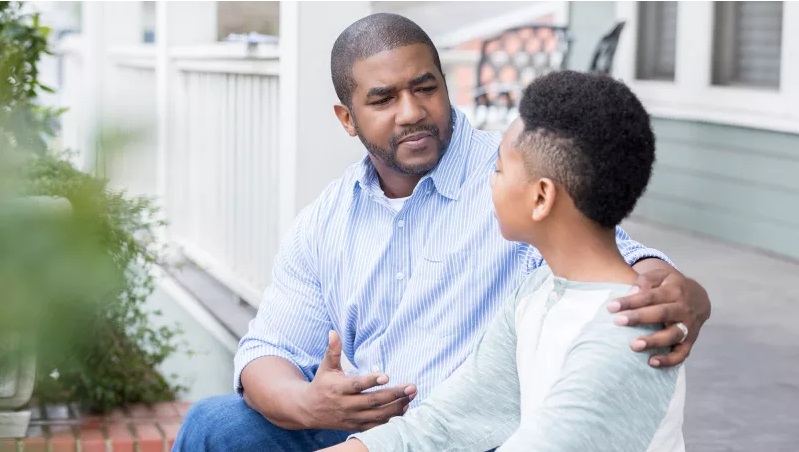
The human father is a link between God the Father and His children. He is the voice of the Father that our children cannot hear, the face of the Father that our children cannot see, and the touch of the Father that our children cannot feel. If fathers turn their hearts to their children, their children will turn their hearts to God. If fathers listen to their children, their children will know the listening heart of God. If fathers show mercy to their children, their children will discover the merciful heart of God. The human father is indeed the visible icon of the heavenly Father.
Why do we so desire a father’s approval? Because we want to be approved by God the Father. Conversely, when we struggle with our belief in the presence of God, in the love of God and in the faithfulness of God, it is because we have struggled to see presence, love and faithfulness in our own fathers.
Paul Vitz, in his book, Faith
of the Fatherless: The Psychology of Atheism, discovers a startling
pattern: atheism arises in people with absent, deceased or abusive fathers. Disappointment
in one’s earthly father frequently leads to a rejection of God. By contrast, prominent
defenders of religious belief – and he includes Blaise Pascal, John Henry
Newman and G.K. Chesterton – were blessed with attentive, loving and caring
fathers.
Look around at the world today. An increasingly fatherless world is an increasingly secular world. Look at the absence of men in church, and the ease with which their children disappear from it once they hit their teens. Look at the research which shows that, if the father is the primary church-goer and living example of faith, his children have a greater likelihood of practising the faith into adulthood than even if both father and mother regularly practise their faith. Where just the mother attends church, there is the least likelihood that the children will continue practising their faith into adulthood.
Why? Echoing St John Paul the Great, Cardinal Ratzinger provides an answer:
“Human fatherhood gives us an anticipation of what [God the Father] is. But when this fatherhood does not exist, when it is experienced only as a biological phenomenon, without its human and spiritual dimension, all statements about God the Father are empty…” [Palermo, 2000]
‘Fatherhood experienced only as a biological phenomenon’: this is sex without considering the consequences, feckless fathers leaving behind single mothers, sperm donors turning fatherhood into a commercial transaction. Any biological act that is not followed up with the commitment and duty of fatherhood.
‘All statements about God the Father are empty’: how can we say that God the Father is good, when our own father abused us? How can we say that God the Father is loving, when our own father left us when we were children?
Cardinal Ratzinger continues:
“The crisis of fatherhood we are living today is an element, perhaps the most important, threatening man in his humanity. The dissolution of fatherhood and motherhood is linked to the dissolution of our being sons and daughters.”
Interestingly, one of the antonyms of ‘dissolution’ is ‘inauguration’. It’s a wonderful thing that true manhood helps inaugurate – invest or initiate – others into the family of God. It’s a very majestic term and a very stately activity. Indeed, St Paul says, “I bow my knees before the Father, from whom all paternity in heaven and on earth takes its name”.
Catholic manhood knows its responsibilities
Let’s return to St John Paul the Great and the quote from Familiaris Consortio. Here is the line in context:
“In revealing and in reliving on earth the very fatherhood of God, a man is called upon to ensure the harmonious and united development of all the members of the family: he will perform this task by exercising generous responsibility for the life conceived under the heart of the mother, by a more solicitous commitment to education, a task he shares with his wife, by work which is never a cause of division in the family but promotes its unity and stability, and by means of the witness he gives of an adult Christian life which effectively introduces the children into the living experience of Christ and the Church.”
Let’s pick this apart for the next few paragraphs. What actual duties of mature Catholic men are described here?
He ensures the harmonious and united development of all the members of the family
A Catholic father corrects, disciplines, teaches, treats everyone justly and with fairness; he exhorts, encourages and provides opportunities to experience new things in life. He allocates chores and duties and provides rewards and celebrations. He looks for the strengths in his children and develops them; he looks for their weaknesses and strengthens them. He establishes a family culture, family times and seasons and helps to contain any extremes in the ebb and flow of family life.
He exercises generous responsibility for the life conceived under the heart of the mother
A Catholic father is present and committed. He welcomes conception. He kicks his selfish boyish habits and gives the ensuing time and energy to his family. He settles the baby, feeds it, wipes its bum and changes its nappy. He gets down on the floor to play; he takes the children into the garden, the workshop, the countryside; the resources he has and the money he earns he pours into their needs rather than his own.
He has a solicitous commitment to education
A boy’s successful transition to manhood comes about from learning how to be a man from other men, and then having his masculinity affirmed by those men. A girl will learn likewise from her mother. In practical matters, a father and a mother should teach skills and virtues necessary for the rounded education of both sons and daughters.
However, it is in spiritual matters that the father has a primary responsibility to educate.
St Augustine emphasises the father’s spiritual headship of his family in his Sermons on Selected Lessons of the New Testament. He goes so far as to compare the father’s role in the home to that of bishops in the Church:
“Discharge our office in your own houses. A bishop is called from hence, because he superintends, because he takes care and attends to others. To every man, then, if he is the head of his own house, ought the office of the Episcopate to belong, to take care how his household believe, that none of them fall into heresy, neither wife, nor son, nor daughter… Do not neglect, then, the least of those belonging to you; look after the salvation of all your household with all vigilance”. [SSL XLIV]
Or St Paul to the Corinthians,
if you like:
“Be watchful, stand firm in the faith, act like men, be strong. Let all that you do be done in love” (1 Corinthians 16: 13-14).
His work should never be a cause of division in the family but promotes its unity and stability
The modern working world doesn’t make it easy for us, but a Catholic father will try to find a job close to home, a career that allows flexible hours or opportunities to work from home. He will make prudent decisions about how much overtime he does, about how much travel he undertakes, about whether the extra cash from that promotion is really worth the additional hours away from the family. Men have a tendency to define and affirm their masculinity by their careers and incomes, or use their hard work to excuse their lack of presence to their families. Man is not defined by occupation but by vocation.
He gives witness of an adult Christian life
An adult Christian life is a life of virtue. Did you know that the Latin word for man is vir, which is at the root of the words virtue and virility? In using vir to denote ‘a man’ it also implies those qualities and properties which constitute a man. Vir is used in the Latin as a term of respect and it often signifies, emphatically, a hero.
Virtue and virility are the core foundations of becoming an authentic adult Catholic man. Virtue is about being a good man, and virility is about being good at being a man. Virtue is what makes virility noble. Virility is what makes virtue active.
Aristotle’s Golden Mean states that any virtue – let’s take courage as an example – sits between two extremes: a deficient vice and an excessive vice. The deficient side of courage would therefore be cowardice and the excessive side, recklessness.
Giving witness to an adult Christian life is a continuous, heroic determination to move away from those extremes and towards virtue – or, as The Catechism of the Catholic Church defines it, “a habitual and firm disposition to do the good.”
Virility brings us back to the four divinely appointed
laws of primacy, procreation, provision and protection and to some extent also describes
our capacity in each area. The
degree to which we have developed our capability in all four roles is the
degree to which we might be considered virile, or good at being a man.
He introduces the children into the living experience of Christ and the Church.
What
is the living experience of Christ and the Church? It is the unrestrained,
limitless, unbidden and unprompted, gratuitous abandonment and sublimation of
oneself and one’s own desires for the good of another. In short, complete
self-sacrifice.
And how does a father introduce his children into this living experience? Through his love of their mother.
Marriage, as someone once said, is an ongoing, vivid illustration of what it costs to love an imperfect person unconditionally … Just as Christ loves us. Through a selfless love of their mother, the father shows his children how Christ loves us and His Church. As the Venerable Fulton Sheen says, “Suffering and responsibility – these are the hallmarks of masculinity”.
And it ain’t easy – my wife can be as annoying as hell, and I struggled for many years of our marriage expecting her to love me as I wanted to be loved and resenting her when she didn’t. Love became conditional – I would only repay it if I felt I was receiving it.
What I didn’t realise is that, to love as a man like Christ is to always make the first move: to be the first to express sorrow, the first to forgive, the first to show a sign of affection, the first to break the cold wall of silence. St John the Evangelist writes: ‘We love, because He loved us first’!
St. John Chrysostom exhorts husbands:
“… And even if it becomes necessary for you to give your life for her, yes, and even to endure and undergo suffering of any kind, do not refuse. Even though you undergo all this, you will never have done anything equal to what Christ has done. You are sacrificing yourself for someone to whom you are already joined, but He offered Himself up for one who turned her back on Him and hated Him.
In the same way, then, as He honoured her by putting at His feet one who turned her back on Him, who hated rejected, and disdained Him, as He accomplished this not with threats, or violence, or terror, or anything else like that, but through His untiring love; so also you should behave toward your wife.
… So the Church was not pure. She had blemishes, she was ugly and cheap. Whatever kind of wife you marry, you will never take a bride like Christ did when He married the Church; you will never marry anyone estranged from you as the Church was from Christ. Despite all this, He did not abhor or hate her for her extraordinary corruption …” [Homily XX]
It’s easy to wallow in resentment and self-pity in our relationships. It’s easy for men, like the first Adam, to blame the woman for all the trouble and strife in their lives, but that’s a boyish response. The battles between the sexes will only ever be over when we men love first, when we take our computer games, our fast cars, our banter, our addictions, our lewdness, our desire for power, and nail them firmly to the Cross of self-discipline and self-denial. Then with our arms wide open and our hearts pouring out our love, we will hear our wives and our children say, “Behold the man!”
Afterword
Like committing to the gym after years of inactivity, committing to authentic manhood after years of juvenile indolence is a challenge.
Firstly, we don’t feel like we have the energy! This all sounds exhausting! Where do I start?! Secondly, once you hit the gym, it’s depressing how much further ahead other people appear to be, and how much work you have to do to get there. And finally, it’s not until we put ourselves in a position of duress and vulnerability that we find the righteous anger and the inner wherewithal to deal with and root out our apathy.
But start small. St
Josemaria Escriva writes:
“Will-power. A very important quality. Don’t despise little things, for by the continual practice of denying yourself again and again in such things — which are never futile or trivial — with God’s grace you will add strength and resilience to your character. In that way you will first become master of yourself, and then a guide, a chief, a leader: to compel and to urge and to inspire others, with your word, with your example, with your knowledge and with your power”. [The Way, 19]
If you’re reading this feeling the inertia and the exhaustion of what you need to do to be a man, know that someday, somewhere down the line, those innate masculine laws will break through and you will go, dammit, something has to change! I will get off the couch, I will go to the gym – I will step up and become a man.
Even if you are not yet a father, or that time seems a long way off, there is much you can do to prepare, to cast off your boyish habits and to take up your responsibilities.
But know this also, to take your fitness for manhood seriously, you need to be taught how to do it correctly, you have to start light, you need a coach to guide you and to hold you accountable, you need to work on areas that are injured or weaker than others – and you will plummet to depths you never knew were there and rise to summits you never imagined. And you’ll need buddies along the way to cajole and motivate you, to laugh at and with you and who push you to achievements beyond your expectations. Manhood is a challenge, but men are built for challenges
Let me end by paraphrasing a quote from Bishop Daniel Jenky of Peoria, Illinois. Where he is speaking of Catholicism, let me reference manhood:
“The age of casual Manhood is over, the age of heroic Manhood has begun. We can no longer be men by accident, but instead be men by conviction!” [cf Sermon, 14th April, 2012]
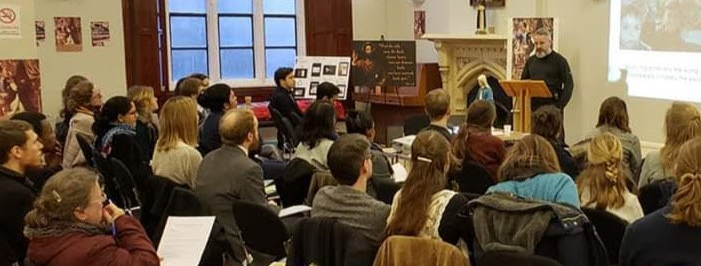
Adapted from a talk given to the Catholic Medical Association young peoples’ retreat, St Dominic’s Church and Rosary Shrine, London, 9 Feb 2019
It has become an annual Christmas ritual that my wife and children sit down and watch the whole of the extended version of The Lord of the Rings: hot chocolate, Christmas nibbles, dressing gowns and slippers – for about three days! I like the films, but grew up preferring the books, so it’s a great opportunity for me to slip off for as much peace and quiet as one can get with a background of battle cries and an intensifying film score.
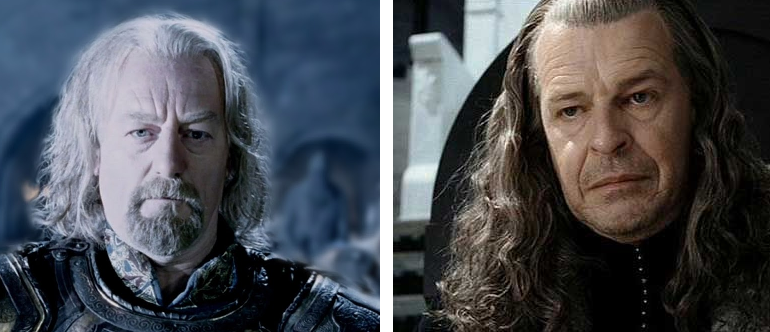
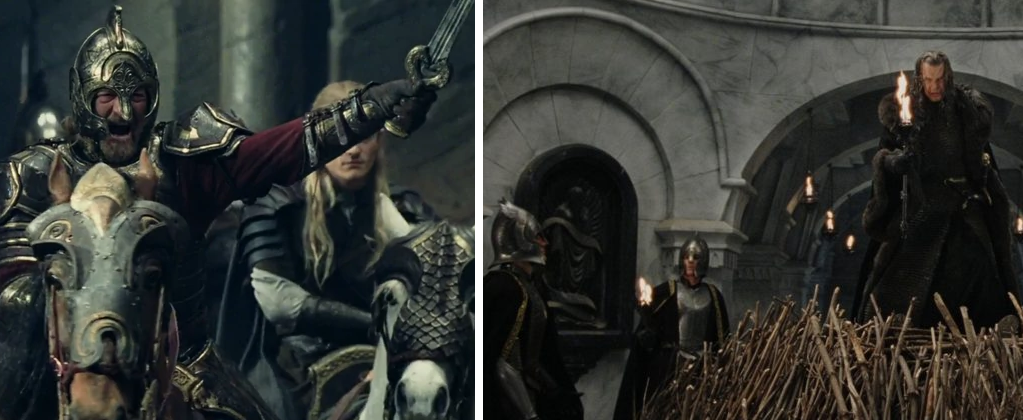
The children love being re-submerged into the world of Middle Earth and are at the age where they see beyond the fantasy to the allegorical themes woven throughout. Something that struck them this year was the very different response to the crisis of evil faced by two of the key characters in the latter parts of the series: Theoden, King of Rohan, and Denethor, Steward of Gondor.
Theoden, King of Rohan and Denethor, Steward of Gondor
When we first meet Theoden in the film, he is under the thrall of the evil wizard, Saruman, who has used his powers to take possession of Theoden’s body, keeping him bound and bowed in his throne like a frail old man in a care home, inert, incapacitated and unable to rule his Kingdom. Saruman’s servant, Wormtongue, aids this bondage by pouring slippery words into the King’s ear to dull his mind. Theoden is only released from these chains by Gandalf the White exercising – or perhaps exorcising – a greater power as he casts Saruman out and restores Theoden to his right mind and his rightful position.
Gandalf then facilitates Theoden’s recovery by suggesting that his hands would remember their old strength better if they grasped his sword, implying both that he should get a proper grip on his manhood – gird his loins, as it were – and take up the symbol of his obligation to carry out the actions appropriate to being king. Which he does: he quickly comes to his senses, recognises his failings and puts his house in order. He metes out justice to those who deserve it, he buries the dead, he restores broken kinship and sonship, he gathers the clans, he protects his people and then rides out to meet evil in mortal combat. Having put his demons to the metaphorical sword, he dies a heroic, sacrificial death at the sword of a demon of Middle Earth.
Denethor, by contrast, first appears as a noble lord in absolute control of his household. He sits as Steward of the great city Gondor where his magnificent armies, under the leadership of his warrior sons, have been holding back the menace of Sauron’s hordes at the borders of Middle Earth. Denethor, however, has a dark gnawing secret – unbeknownst to anyone, he holds one of the palantir, a seeing stone, which provides revelations or visions of the world around him. However, Sauron manipulates the palantir to show Denethor scenes of his vast armies, his power, his destruction and his impending victory.
After the news of the death of his eldest son, Denethor spirals into despair (“You may triumph in the field of battle for a day, but against the power that has risen in the east, there is no victory“) and his final act is not to ride out to meet the enemy, but to take his wounded younger son into the mausoleum, set a funeral pyre and attempt to take both their lives. His son is rescued, but Denethor dies a dishonourable death, consumed by his own demons of doubt and hopelessness.
Hope and despair
The parallels with our own times and circumstances are stark. We live in an age where men of faith are few and far between, and many of faith and none are hobbled, like Theoden, by their own weaknesses and lassitude. They are no longer masters of their own houses, having been made impotent by a supply of junk food, video games, porn and other drugs, and fed a diet of watery platitudes about their emotive and metrosexual behaviour and about how well they are dealing with their toxic issues. They have let go of the traditional masculine strengths of leadership, provision and protection.
Satan sees this
as a watertight strategy for defeating the family of God: shackle the good men
and when the time comes for the final attack there will be no one ready or
strong enough to resist.
Even those men, like Denethor, who are battling hard on every moral and spiritual front, can suddenly fall prey to despair and give up all hope. When we look into our smartphones – today’s seductive palantir – we can be tempted to give in to existential desolation in exactly the same way as Denethor. If all we measure life by is the news and views of the world around us, then Satan appears to be winning. This is not just about what we hear of extremism, environmental destruction, poverty, political and economic turmoil, but also about the vivid demonstrations of the spirit of the times: the emasculation of men, the destruction of fatherhood and family life, aggressive atheism, gender ideologies, unrestrained hedonism and an utter disregard for the truth.
The Palantir and its modern day successor.
Like Theoden and Denethor, we men have a choice before us. Either we arise from our stupor and put our houses in order, then pick up our weapons and join the battle of our lives, or we let the effluence of fear and despair creep deep into our souls and we give up entirely. Every individual man, in his own environment and with his own particular set of circumstances, has that singular choice to make: get a grip or give up.
For Catholic men today, that choice may not seem as glorious as a fantasy role in Middle Earth, but it is no less heroic: hold fast to the faith and resist evil, say your prayers, receive the sacraments, restore proper leadership in your household (or church), lay down your life for your wife (or parish), pass on the faith to your children (or parishioners), be self-disciplined, perfect the virtues, let go of material possessions and ambitions, exercise, read good books, be a light to the world. All this we do because we have hope, hope in the rightness, the goodness, the meaning and the fulfilment of all our actions. We also do it because we must: “I wish [this] need not have happened in my time,” said Frodo. “So do I,” said Gandalf, “and so do all who live to see such times. But that is not for them to decide. All we have to decide is what to do with the time that is given us.”
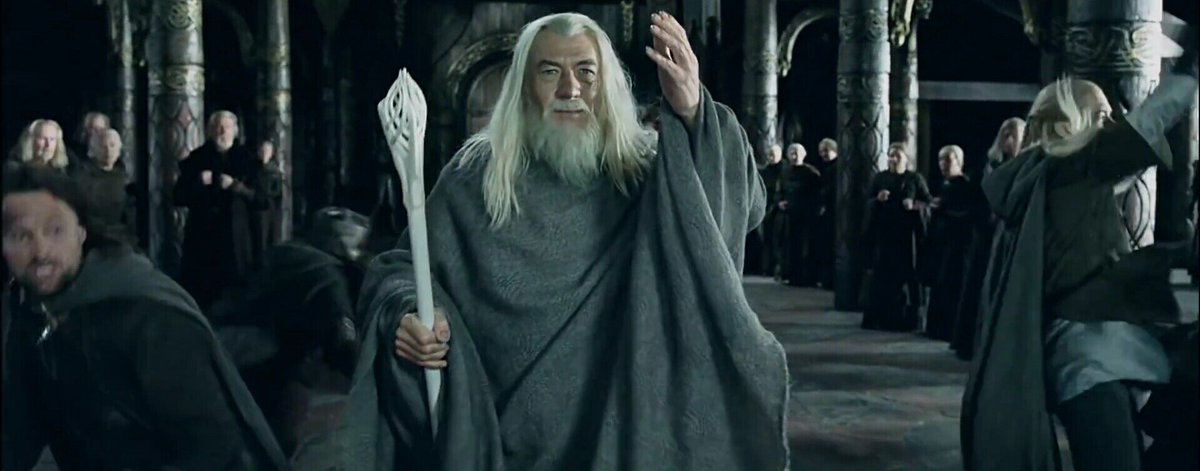
But it’s difficult to do this on our own. Fortunately for King Theoden, Gandalf was the catalyst for his transformation. Still, Gandalf, too, doesn’t achieve this alone. In a joyous scene of masculine camaraderie – one of my favourites in the film – Aragorn the Ranger, Legolas the Elf and Gimli the Dwarf rock up with Gandalf to the doors of Theoden’s stronghold, stride weaponless through his Great Hall and beat his guards into submission. Their actions enable Gandalf to reach Theoden’s throne and to rescue him from the clutches of Saruman. Bodies lie strewn behind them.
Those are the kind of friends I want! Men who will smash their way in to save me from my captivity with no thought for their own safety! In this Catholic context, I mean men who will unashamedly pray with me and for me, men who will encourage me to Mass and to the sacraments, men who will challenge me to be a better man of faith, men who will stand by me as witnesses to the Kingship of Jesus Christ.
Aragorn, Legolas and Gimli fight the guards, allowing Gandalf to walk to Théoden.
J R R Tolkien was a man of great hope. He coined the word eucatastrophe as a fundamental concept of his mythology. Catastrophe is the point at which a wholly positive narrative is suddenly interrupted by a single, unexpected and calamitous event, plunging protagonists and plot towards a devastating conclusion. A eucatastrophe, on the other hand, is when an appalling and intractable set of circumstances are abruptly alleviated by an equally unlooked for happy turn of events.
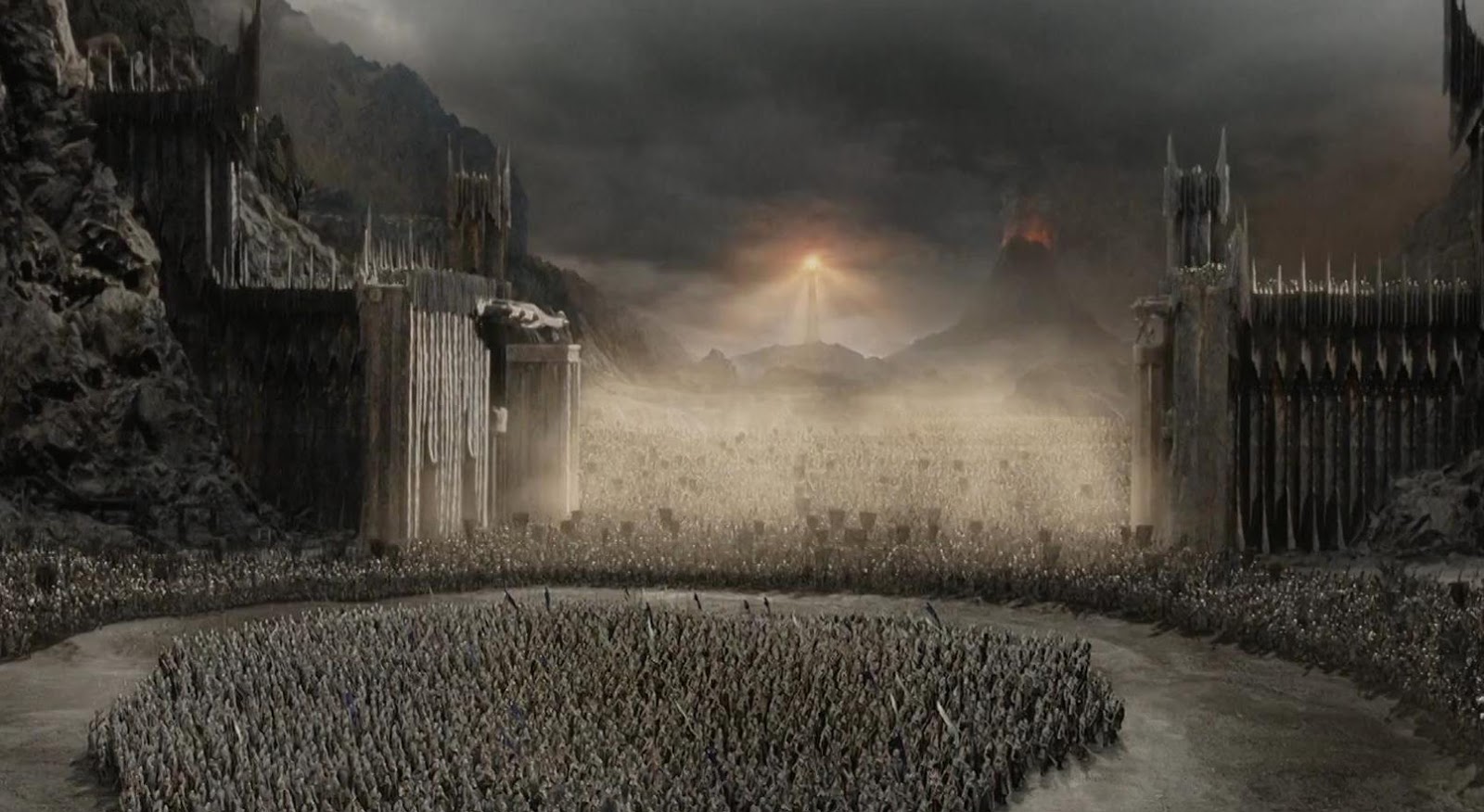
In LOTR, we have that wonderful example of Aragorn’s small band of men grouped outside the Gates of Mordor for a final stand, having been told that Frodo is dead. The uncountable hordes of Mordor are about to be unleashed upon them when Frodo’s own intense drama suddenly reaches its conclusion. The Ring is destroyed, along with it the power of Sauron, and his armies flee the battlefield.
Aragorn’s army, surrounded at the Black Gate of Mordor
A eucatastrophe does not simply come from nowhere. It comes from each character in the narrative still holding on to hope when all seems hopeless, still keeping to his post when others flee, still unfailing in the duties given to him even when he has no idea if anyone else is carrying out theirs, even when he thinks he is alone and defeat is upon him. If Aragorn hadn’t held his ground outside the Gates of Mordor and distracted Sauron’s gaze, Frodo wouldn’t have made it to Mount Doom; if Frodo hadn’t made it to Mount Doom, Aragorn would have lost the battle that distracted Sauron.
Tolkien writes:
“I coined the word ‘eucatastrophe’ as the
sudden happy turn in a story which pierces you with a joy that brings tears.
And I was led to the view that it produces this peculiar effect because it is a
sudden glimpse of Truth. Your whole nature chained in material cause and
effect, the chain of death, feels a sudden relief as if a major limb out of
joint had suddenly snapped back. It perceives that this is indeed how things
really do work in the Great World for which our nature is made. And I concluded
by saying that the Resurrection was the greatest ‘eucatastrophe’ possible…”
So, keep being men of faith – because the moment you give up is the moment when victory is about to be secured; the moment you give up is the moment when you unwittingly halt someone else’s spiritual accomplishment; the moment you give up is the moment when the delicate balance of your spiritual ecosystem – your family, friends and fellow Catholics – most needs you to remain steadfast. Catholic Man UK has been set up to reassure men that in every parish, in every diocese across the country, there is a band of valiant warriors holding true to the faith. The war against Satan has, of course, been won, but there are many battles ahead against the remnants of his army.
We use cookies to protect this website from spam, and optimise our website for the best service to our visitors.
Functional
Always active
The technical storage or access is strictly necessary for the legitimate purpose of enabling the use of a specific service explicitly requested by the subscriber or user, or for the sole purpose of carrying out the transmission of a communication over an electronic communications network.
Preferences
The technical storage or access is necessary for the legitimate purpose of storing preferences that are not requested by the subscriber or user.
Statistics
The technical storage or access that is used exclusively for statistical purposes.The technical storage or access that is used exclusively for anonymous statistical purposes. Without a subpoena, voluntary compliance on the part of your Internet Service Provider, or additional records from a third party, information stored or retrieved for this purpose alone cannot usually be used to identify you.
Marketing
The technical storage or access is required to create user profiles to send advertising, or to track the user on a website or across several websites for similar marketing purposes.